SALINA GROUP
The Upper Silurian Salina
Group in northern and northeastern Ohio is a subsurface, evaporite-rich
succession with economic concentrations of rock salt. Evaporites are
chemical sedimentary rocks that form from the evaporation of water (usually
seawater) and the precipitation of dissolved minerals. Rock salt and rock
gypsum (“gyprock”) are the most common evaporites. Rock salt is composed
entirely of halite (sodium chloride - NaCl), while rock gypsum is composed
dominantly of gypsum (hydrous calcium sulfate - CaSO4·2H2O).
Another evaporite is the less common rock anhydrite, composed of
anhydrite (anhydrous calcium sulfate - CaSO4). Rock salt is
mined in the subsurface of the Cleveland area and underneath parts of adjacent
Lake Erie.
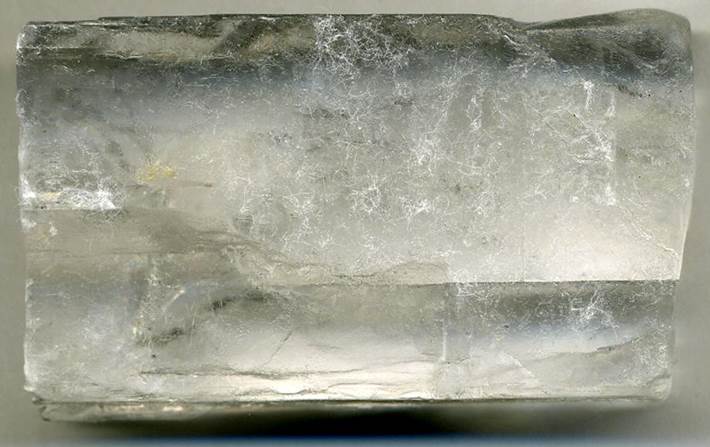
Halite - large crystal (6.5 cm
across) from the upper F1 Salt Bed (17' thick), ~mid-Salina Group, ~mid-Cayugan
Series, ~mid-Upper Silurian.
Locality: Fairport Mine (~1900-2000'
below the surface; mining is principally underneath Headlands Beach State Park
& adjacent Lake Erie), western side of the Grand River, Fairport Harbor,
northwestern Painesville Township, northern margin of Lake County, northeastern
Ohio, USA.
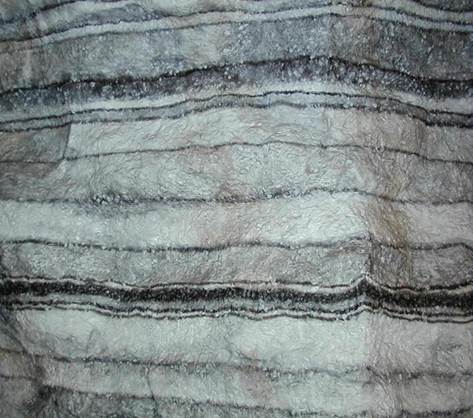
Simulated wall of subsurface
Salina Group evaporites on display at the Cleveland Museum of Natural
History. This wall accurately shows the bedding characteristics of rock
salt & rock gypsum in the underground salt mines.
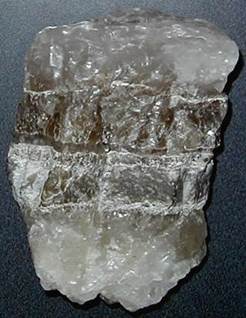
The pic below shows a
specimen of interbedded rock salt and rock anhydrite. The gray band is
the anhydrite (3rd bed down from the top of the sample). This sample
comes from Cleveland's Akzo Mine.